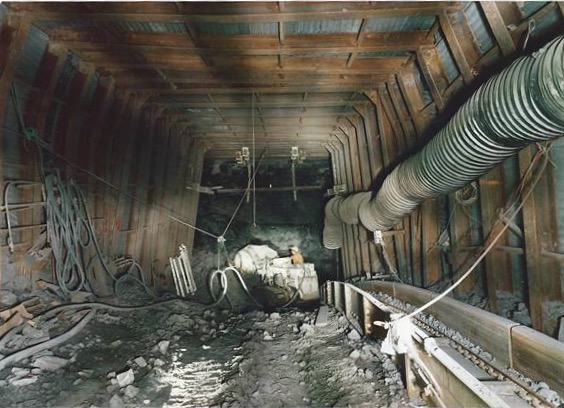
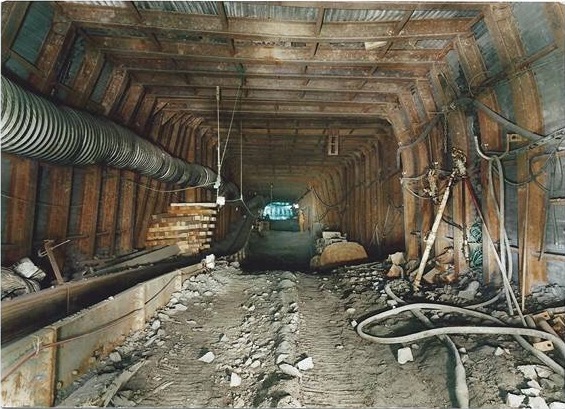
When the Gascoigne Wood drifts were finished and the spine tunnels were underway, the transport system to supply the two headings and provision of manriding facilities were installed. Due to the lengths, extreme temperatures and the huge amount of heading supplies needed on a daily basis in the spine tunnels, the transportation system had to be designed to be very robust and reliable.
The drifts had rope haulages with manriding cars, operated from a surface engine house. The haulage engines were very similar to a small winder operating as a winch.
The Qualter Hall Manrider Haulage Engine.
The rope haulages had captivated mine cars and ran to the 1680m mark in the North Spine Tunnel and 1600m mark in the south spine. The rope haulages were both capable of carrying 21.5 tonnes of materials. The south drift had manriding capability of 96 men with the north only 8 men capacity. The Drift haulages used a system of communication called a Leaky Feeder which had an aerial cable running the length of the haulage with a radio system on board the haulage drive car.
Drift Haulage Manriding Car.
At the inbye end of the rope haulages Hunslet-GMT 150hp diesel rackatrack locomotives took over to transport the men and materials into the headings.The diesel locos were used until the Gascoigne Wood spine tunnels were completed. The Hunslet-GMT locos worked in extreme temperature and overheating was always a problem. The fitters who worked on these machine devised many ways of keeping them operational using the water from the water range to cool the engine.
Once the spine tunnels were completed the diesel locomotives were phased out and Clayton battery rubber tyred BoBo locomotives were introduced with battery charging and replacement station in the spine tunnels.
Clayton BoBo with manrider cars.(photograph shows BoBo from Rossington Colliery)
Becorit battery changing station.
Manriding conveyors were never used at Gascoigne Wood, unlike the other mines in the complex, due to the speed and complexity of the conveyor systems used for the production of the Selby Coalfield.
The spine tunnel developments at Gascoigne Wood were the longest and most complex mining developments ever undertaken in the UK. The south spine Robbins T.B.M. was the first to be completed on 22nd June 1987. The north spine tunnel, driven by a Thyssen Meco ( Paurat ) Titan E134C Roadheader, was completed on 24th November 1990.
The south spine tunnel was equipped with 14,885 horsepower ( 10,100KW ), 1.3m wide, 28.1mm thickness, steel cord conveyor capable of carrying 2200 tonnes of coal per hour at a speed of up to 8,4m/sec . It was 12,232m in length and weighed 2,500 tonnes when empty and transported coal 805m from lowest point to surface. The drive was a Direct drive, twin E frame DC winder motors (5050kw) and was designed by Anderson Strathclyde and REI and was the most powerful conveyor in the world when installed.
Information plate on A.S.L.Conveyor Drive
It was designed to handle the entire coal production of the Selby Coalfield and was the first of the spine tunnels to be fully operational.
Gascoigne Wood South Spine Steel Cord Conveyor.
The North Spine tunnel, when operational was equipped with a 11,084 horsepower (8750 kw), direct drive, twin D frame winder motors rated at 4375 kw, 1.05m wide cable belt. The length of the conveyor was 9,650m with a tandem accelerator conveyor, 3,000m in length and 1.35m wide, loading from the inbye end, on to the cable belt.
The Cable Belt Tandem Conveyor.
Both conveyors were capable of 2,000 tonnes per hour. It was designed by Cable Belt Conveyors Limited and was also capable of handling the full production of all the five mines.
Wistow Staple Bunker delivering coal on to the cable belt.
Deputy inspecting the cable belt
When the Selby Complex was fully operational the Gascoigne Wood spine tunnels were fed from the five producing mines via multiple vertical bunkers. The staple bunkers were supplied with coal from the Barnsley seam which is 60m above the Gascoigne Tunnels.
During production the Gascoigne Wood conveyors had to run constantly and stoppages were very rare due to the sheer amount of production from the five mines. Any stoppages, other than safety related , were planned so that production could be re- directed to either of the main conveyors. At the bottom of each staple bunker, a monitored and controlled feed of coal was achieved using Westerland Feeders. These feeders had load cells so coal feeds could be measured and controlled. All the bunkers were controlled by Gascoigne Wood surface control room. The feed of coal was delivered via hoppers with hydraulic doors, each with a capacity of 85 tonnes and could direct the coal supply to either of the spine tunnel conveyors. During the spine tunnel developments a system of boreholes from Wistow Mine to Gascoigne were planned for access. The borehole at V3s was a small bore staple shaft. The next cross slit at V4s was originally a single bunker but later became West and East staple bunkers, at 4.5m diameter, each with a Westerland weigh feeder. The coal clearance from Wistow Mine to Gascoigne Wood Mine started in January 1983 in order to start production at Wistow Mine in July 1983.
Wistow Mine staple bunkers and boreholes
As the Gascoigne Wood spine tunnels progressed further staple shafts and access shafts were made. At 7208m a ventilation shaft from Wistow was made. The next cross slit was called V7s where a staple shaft was sunk. The next cross slit was V8s where two staple bunkers were sunk with access ladders to Wistow Mine.
V8s Heading during construction.
V8s cross slit when completed.
Vent slit during construction.
This cross slit had a north and south staple bunker when completed. Just inbye of this slit at 7916m, a second ventilation shaft was constructed and the shaft at 7208m was disused.
Wistow Mine staple shafts and boreholes
The south spine Robbins TBM tunnel progressed very well , but the north spine tunnel slowed due to very bad ground conditions which required back ripping at a later date.
Amco heading men back ripping in South Spine Tunnel.
In early 1986 The south spine Robbins TBM heading broke the world record for a Tunnel Boring Machine when the AMCO heading teams mined a record of 19m in one shift, 43m in a day and 152.4 metres in a week breaking a record from 1981.
The world record breaking AMCO Heading Teams January 1986
The next production connection was with Stillingfleet Mine. This staple bunker was a revised version of original plans to have dedicated staple bunkers at Stillingfleet Mine and North Selby Mines. The revised plan was to have a conveyor through Stillingfleet Mine from North Selby Mine and deliver the combined production through one staple shaft when North Selby was in full production.
Stillingfleet / North Selby Connection.
The south spine tunnel progressed well until late 1986 when the TBM hit very soft conditions. The tunnel boring machine was unable to cut in the soft rock and virtually stopped. A connection with Riccall Mine was imperative as the coal production from Riccall and Whitemoor Mines depended on Gascoigne Wood for the coal clearance. The only answer was a heading from Riccall Mine back towards Gascoigne Wood so a heading started from Riccall Mine in early 1987. The Stillingfleet Connection heading was well established, when the south spine TBM overcame the soft conditions using a concrete grouting system. The heading progressed well to the final point and completed the spine tunnel on the 22nd June 1987.
Gascoigne Wood Spine Tunnel connection with Riccall Mineat completion of both Spine Tunnels.
As you can see from the plan above the ventilation borehole, access borehole and coal clearance staple shafts are shown.
A 1in 7 drift connection was made from Riccall and booster fans were installed and powered from a dedicated supply in Riccall Mine pit bottom substation.
To ensure the safe access and egress in and between the spine tunnels at Gascoigne Wood Mine, cross slits were made as mentioned in a previous post. These were used for ventilation, substations, loco pass byes, charging stations, for the locomotive fleet, pumping stations, staple bunker access and ventilation/ access boreholes. To enable the safety of the men in the case of a fire in the spine tunnels, smoke doors were installed in these slits. The doors could be operated remotely from the surface control room in an emergency situation.
One of the V slits with electrical equipment and conveyor control panels.
V11s ventilation slit smoke doors
To keep the 25km of spine tunnels stone dusted, was as you can imagine, a major job. Planning was imperative to attain high standards in such a massive complex of tunnels and cross slits due to distances to travel. Gascoigne Wood used various methods of applying the stone dust.
Cryogenic stone dust train
The cryogenic (compressed nitrogen) system was used to deliver huge amounts of stone dust in the spine tunnels. This system was used at most of the mines in around the Selby Coalfield.
Cryogenic stone duster in use.
Stone dusting at a Westerland feeder slit in the south spine tunnel.
Compressed air was available along the spine tunnels with compressor house situated at various points. It was used for stone dusting at transfer points as seen above using the hopper and lance.
Keeping the conveyors maintained and safe was also a huge job. A system was devised to replace defective rollers using a loco mounted portable lifting station to take the weight off the conveyor of the defective roller to enable replacement. Inspection were done using a purpose designed loco carriage which was low slung to enable inspections on the move.
Replacing a defective conveyor rolleron the ASL conveyor.
Conveyor inspection train.
Teams of men were also deployed to keep the spillage to a minimum. As you can imagine moving 12 million tonnes of coal along a conveyor system will always cause some level of spillage.
ASL conveyor spillage.
Cable belt spillage.
Compressor Houses.
As mentioned earlier compressed air was used throughout the spine tunnels. Back ripping was another job which required regular attention. Long sections of both spine tunnels were backripped and dinted. Cable bolting was also used at various points in the tunnels.
Installing 26 ft cable bolts.
Gascoigne Wood had a fleet of Clayton BoBo locomotives for transporting men and equipment from the drift bottom to inbye working areas. Due to the sheer length of the tunnels, loco charging and battery changing stations were sited along the tunnels in either specially widened roadway or passbye slits.
Changing a BoBo battery.
Becorit equipment for changing batteries.
My sincere thanks to Neil Rowley for allowing me to use his photographs and information.
The Gascoigne Wood South Spine Tunnel was a very new concept in coal mining roadway development. A Thyssen 12-35 FLP Tunnel Boring Machine had been trialled in an 476m overburden undersea heading development at Dawdon Colliery starting in 1975 with varying success. The heading was a 3.6 m circular tunnel driven through coal measures in mudstones and fine sandstones with broken zones of coal, shalestone and seatearth. The machine progressed 1086m in 1975 but gradually proved to be unsuccesful completing only 1398m by 1978 when it was abandoned.
The Robbins 193-214 TBM was designed to fulfill the high speed drivage required for the development of the Selby Complex coal clearance tunnels exiting at Gascoigne Wood Drift. It was a 5.8m diameter TBM designed to have advance rates of over 120m per week.
The Robbins TBM Erection Chamber.
The cutting head consist of a disc cutter rotating at five revolutions per minute scooping heading material onto a rear facing conveyor. The cutter head, which contains 42 roller cutters, is designed so that they can be changed from inside the head at the rear of the face for safety.
This picture gives you an idea of the sheer size of this machine and the size of the erection chamber required to build it which was 40m long and over 8.5m high. The T.B.M. was designed and built at the Robbins factory in Seattle, U.S.A. The T.B.M. was tested and then shipped to the Gascoigne Wood Mine erection chamber for the build up and testing before being accepted for use underground. The T.B.M. cut a 5.8 metre circular tunnel, then a 5 piece circular girder was installed at 1m centres. The heading roadway, behind the machine, was then backfilled, using the cutter muck, up to 1.2m. The conveyor running through the machine had a controllable delivery point, to deliver the muck, into the roadway at the back of the machine. This created a flat base, in the circular roadway, to allow for services such as the conveyor to deliver development muck to the surface and rails to be installed for the supplies to the heading.
The Robbins Miner.
The 240 tonne 193-214 T.B.M. consisted of seven sections :-
The Cutter Head,
The cutter head carried the disc cutter and rotated at 5 rpm. It scooped the material, cut at the face, and transferred it via chutes on to the internal machine conveyor. It consisted of 5, large bolted sections. It allowed for changing of the rotating cutters from inside the cutter head structure for safety purposes.
2. Cutterhead Support and Main Beam,
The cutter head shield provided the support for the main bearing mounts, ring gear seals and gear reducers. It transmitted all the cutting and steering torque forces to the main beam. It also provided extending fingers, in the upper section, to the ring beam erection area. The main beam was bolted to the rear of the shield and slid within the gripper section at the rear of the machine. Its main function was to transmit forces to the main gripper assembly and also housed the machine conveyor.
3. Gripper and Propel,
The gripper assembly comprised of the gripper shoes, cylinder, gripper carrier, torque and propel cylinders. During cutting operations the gripper shoes were held against the tunnel wall whilst the propel cylinders pushed the machine forward against the gripper assembly. This allowed the machine to be steered.
4. Machine Conveyor,
The hydraulic machine conveyor was situated inside the main beam and delivered the heading material to the main clearance conveyor or the heading backfill facility.
5. Rear Support,
The two legs and shoes operated by 2 hydraulic rams which support the machine during the regripping phase.
6. Ring Beam Erector,
This section erected the 5 piece rings girders within 2 metres of the face. It was positioned under the cutter shield fingers
7. Pantechnicon,
This section was supported by a twin monorail system. It carried all the support systems for the T.B.M. and consisted of :-
a) The 120m overlap dirt disposal conveyor.
b) The 10 sections carrying the electrical equipment including 2 x 6.6kv / 1100v 1.5 MVA transformers and air scrubber fan.
c) The auxiliary fan overlap system for face ventilation including a telescopic sectional system for heading advancement.
d) Two hoists for unloading heading supplies from minecars.
e) A series of monorail mounted bogies used for carrying the 6.6 kv type 631 electrical supply cables and water hoses allowing a 200m advancement before a move up is required.
The invert fill was was 20m back from the face and did not require any tamping of material.
The materials needed for the heading was transported on an internal monorail system through the body of the T.B.M.
The dust control system was mounted behind the cutterhead and was connected to the dust collection system mounted inside the machine.
All the hydraulic services operated on an N.C.B. standard 40/60 oil/water emulsion to adhere to the fire resistance standards (HFB). These hydraulic system were mainly 2000 psi but some system parts were operating at 3000 psi.
The outbye side of the pantechnicon, mounted over the conveyor, was the 6.6kv GEC MIVAC electrical supply isolation unit.
The first contract for the drift drivages was placed with Cementation Mining on the 15th July 1977 with site work commencing on the 1st of August 1977. The 1 in 4 Drifts were completed using the modified SB 600 Roadheaders setting circular, waterproof, sealed, round section supports. The waterproof seals were installed at 832m and the drift continued for a short distance until the spine tunnel drivages started. Cementation Mining replaced the drift roadheaders with two, heavy duty Dosco Mk 3 Roadheaders. The South Tunnel continued at 1 in 33 incline to the East on to 1670m from the drift portal, setting 17 x 12 feet arches. At this point an erection chamber was created, 35m long, 8.6m high and 6.8m wide. This erection chamber was created to build the Robbins 193-214 Tunnel Boring Machine designed to drive the South Spine Tunnel. The machine construction was started in July 1981 and completed in October 1981. During the construction of the Robbins TBM, the North Spine Tunnel continued at an average rate of 65m to 70m per week using the Dosco Mk 3 roadheader, reaching 2891m when the contract with Cementation Mining was completed in August 1981.
Dosco MK3 Roadheader
The main reason the North Spine Tunnel continued was the urgency of the connection to Wistow Mine for the initial coal clearance. At the completion of the contract with Cementation Mining a new contract was started with Thyssens who took on the drivages, the South Spine using the Robbins 193-214 TBM. Thyssens replaced the Dosco Mk3 Roadheader with a Meco Titan E134 C Roadheader and the North Spine Tunnel continued.
Meco Titan(Paurat) E134 C Roadheader.
When the tunnels reached 3843m the gradient was changed to 1 in 40 North Easterly . When the contract with Thyssens was completed Amalgamated Construction (AMCO) took the next contract and completed the spine tunnels.
Having talked to a mate who worked at Gascoigne Wood for many years I have a list of the ventilation slits, substations and coal clearance bunkers travelling inbye from the Drift bottom. The connecting roadways between the North and South Spine Tunnels were called V Slits up to number 11 then they were called Bunker Slits.
926m- Pumping Station.
V1 – Locomotive Garage and main 6.6kv 185mm Ring main substation.
V2- Ventilation Slit and Substation.
V3- Ventilation Slit and Wistow Mine Staple Bunker
V4- Originally a Wistow Mine single staple bunker but later a North and South Staple with an East and West Westerland feeder conveyor.
V5- Ventilation Slit and a main 6.6kv 185mm Ring main substation.
V6- Offset slit for battery charging station.
7208m- South Spine ventilation shaft to Wistow Mine. (later disused)
V7- Staple shaft to Wistow Mine. (later disused)
V8- North and South staple bunker with access ladders to Wistow Mine.
7916m- Second ventilation shaft to Wistow Mine. 7208m borehole was disused when this was completed.
V10- Ventilation Slit and Locomotive passbye.
V11- Ventilation Slit.
Bunker 5-Ventilation Slit. Temporary bunker to Stillingfleet Mine and main 6.6kv 185mm Ring main substation.
Bunker 6-Stillingfleet and North Selby Mines staple shaft.
The Stillingfleet Bunker in the South Spine with a Westerland weigh feeder loader.
Between Bunker 6 and Bunker 7 was a 200m slit towards Stillingfleet Mine with a coal clearance borehole used until the complex closed.
Bunker 7-Riccall and Whitemoor Mines staple shaft.
Between Bunker 7 and Bunker 8 was the final inbye 6.6kv 185mm Ring main substation.
Bunker 8- Riccall and Whitemoor Mines staple shaft via Westerland variable speed feeder.
At the bottom of Bunker 7 and Bunker 8 Staple shafts the coal was delivered onto a Westerland weigh feeder conveyor onto a conveyor. This conveyor could direct the coal onto either of the north spine cable belt or the south spine ASL conveyors.
At the furthest point of the spine tunnels was the Riccall Mine connection via a 1 in 7 drift. The Gascoigne Wood / Riccall Mine connection had a dedicated 6.6kv supply to the booster fan supplied from Riccall Mine to ventilate Gascoigne Wood. I was on the team installing this fan in a very hot area of the mine.
This area of the mine also had a connection via an angled access borehole from Riccall Mine to Gascoigne Wood. This 62m shaft, with ladders, was used for access before the 1 in 7 drift was driven.
The 62m inclined access shaft to Riccall Mine
Inbye of the 1 in 7 Drift, Riccall Mine Connection was the stub heading where the Robbins TBM was driven forward and abandoned.